
Staying true to its pioneering spirit and deep respect for the ecosystem it thrives in, the Drappier family, based in Urville in the Aube region, has distinguished itself as the first Champagne House to implement a zero-carbon policy across its vineyards.
Efforts began in 2008, but it wasn’t until 2015 that the house obtained Ecoact certification—an acknowledgment of the substantial investments made both in the vineyard and across the estate to minimise its carbon footprint.
Almost Electric Autonomy
Among the commitments made in the vineyard and cellar, nearly 2,000m² of buildings are now equipped with solar panels, supplying 75% of the estate’s energy needs. The house has also transitioned to electric vehicles and uses biofuels for older equipment that remains in operation. Fossil fuels have been completely phased out. Additionally, charging stations have been installed for visitors and staff, reinforcing the commitment to circular energy use.
A Workhorse for Carbon Neutrality
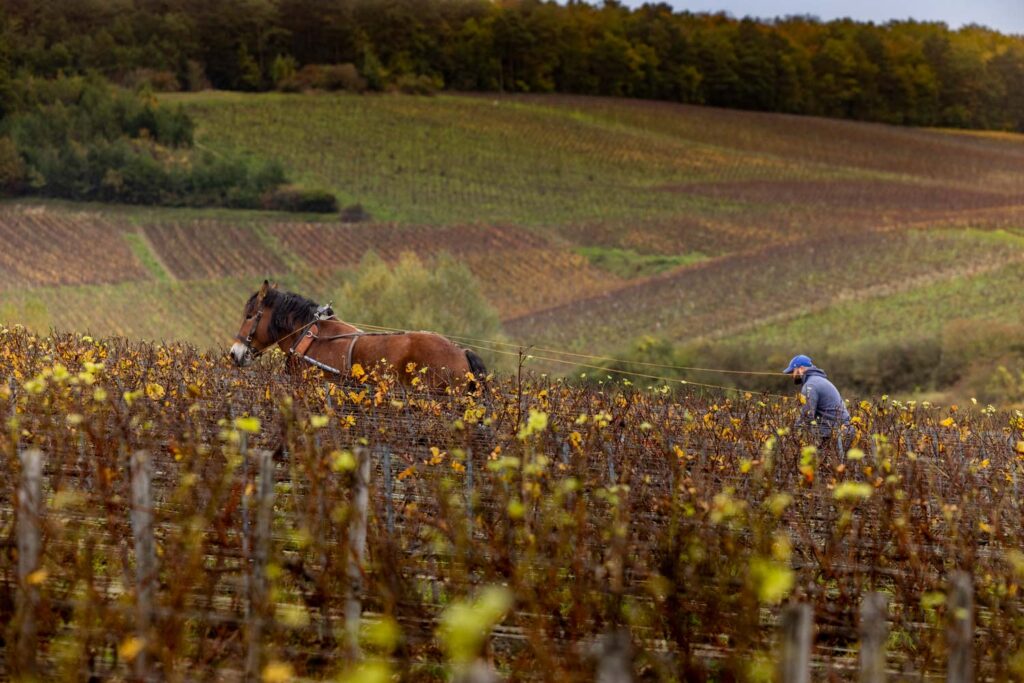
Antoine Drappier, passionate about animals and nature, cultivates select vineyard plots—Fromenteau, Arbane, Petit Meslier, and Grande Sendrée—using Idaho, his Ardennes draft horse. Lighter than a tractor, Idaho prevents soil compaction, helping to preserve biodiversity. By reviving this ancestral method, Maison Drappier blends traditional craftsmanship with eco-conscious commitment, in line with its vision of sustainable viticulture.
Sustainable Packaging Innovations
Drappier has also redesigned its packaging, discontinuing its non-recycled clear glass bottles. The new Drappier brown bottle contains a higher percentage of recycled glass than standard champagne bottles. Special care has been taken with material recycling: bottles tasted on-site are repurposed into candles for a limited-edition collection called Incandescence, while old riddling racks and barrels have been repurposed to decorate the Cornellier vineyard parcel. Inspired by the Loges de Vignes of the past, this initiative was made possible through a collaboration with architecture students tasked with reimagining a “second life” for materials, merging aesthetics and functionality to create a unique tasting space within the vineyards.

Innovation in Transport
In October 2024, a shipment of Champagne Drappier set sail from Le Havre to New York aboard the cargo sailboat Anemos by TOWT. This innovative transportation method drastically reduces greenhouse gas emissions, aligning with Drappier’s environmental commitments. By harnessing wind power instead of fuel, this transatlantic journey also supports marine biodiversity by reducing noise pollution and ocean contamination. The initiative represents a more sustainable vision for maritime transport, perfectly aligned with Drappier’s eco-responsible values.
A New Cave Carved into Urville’s Kimmeridgian Limestone – Spring 2025
Michel and Hugo Drappier have planned the construction of a new underground cellar, taking advantage of the natural self-regulating properties of the limestone rock. This innovative space will benefit from stable temperature and humidity levels without artificial climate control. Covered with earth, the cellar will be topped by a wooden building with walls made of straw and hemp—bio-based materials that provide optimal thermal and humidity regulation. A first in Champagne, this approach blends tradition with modernity, further advancing the estate’s sustainable philosophy.
Permaculture: A Holistic Ecological Approach
The estate’s orchard, vegetable garden, and henhouse are managed using permaculture principles, a practice that naturally complements organic agriculture. This preserved and nurtured biodiversity ensures the best balance between nature and humankind, reflected in every Drappier cuvée.
For 25 years, Urville has been classified as a Natura 2000 protected area. In this healthy ecosystem, André and Michel Drappier have refined their approach to excellence and flavor. Following the organic transition of the late 20th century, they had to rethink production to maximize quality within a limited space. This challenge led them to reassess every aspect of their work—from soil management to shipping. Carbon neutrality is the result of five years of careful planning and a decade of significant investment.


